A First-Timer’s Guide to Buying Research GLP-1 Peptides
A GLP1 Chat Vendors starter guide for buyers. Background reading for research and education only; it is not medical advice.
If you are looking at research-grade tirzepatide or semaglutide for the first time, the market can feel like a maze with no signage. This guide is the map. It explains how buying works from the first search to the doorstep, which claims on a listing deserve scrutiny, what independent testing can and cannot tell you, and the basic bench habits for dealing with a freeze-dried vial. It does not describe personal use of any compound, and nothing here should be read that way.
Start here: what you are actually getting into
A few facts frame everything else, and it is better to meet them now than after your first order.
Research material is not the pharmacy product
Branded tirzepatide and semaglutide medicines have been through large clinical programs and are FDA-approved for specific conditions, namely type 2 diabetes and weight management. That approval belongs to those finished products. A research vial is a different thing: a lab chemical sold without a pharmacist, a prescriber or a package insert, and with no regulator confirming its contents. If you are curious about compounds beyond these two, read the published literature for each one first, because the evidence behind many of them is far thinner.
You are the quality department
Sourcing, labeling, storage conditions and verification all land on your desk. That sounds heavy, but it is manageable when you take it in order and avoid rushing the first purchase. The buyer’s guides cover each topic in turn, and the support team will answer anything that stays unclear.
Slow is normal
Expect a wait of roughly two to eight weeks, with the longer end typical for parcels that start in China. Brands usually answer messages within a day, but with up to 16 hours between U.S. and Chinese time zones, a quiet evening means nothing. Consumer-complaint bodies have no authority over this trade, so the real safeguard is the escrow hold on your payment, not a promise from customer service.
Use the claim process instead of a bank reversal
If a parcel is late, damaged or disappointing, do not try to claw the money back through your bank. Reversals strain the payment channels that every buyer and brand depends on, and they tend to end a relationship with a brand permanently. Message the brand first. If you are asking for a remedy under a purity or fill guarantee, attach a lab result that backs you up. If that goes nowhere, open a claim from your account: your funds stay held while we mediate, which is a stronger position than any after-the-fact dispute.
Protect your privacy from day one
Create an email address used only for this purpose, with nothing in it that points to your real name or employer. Brands send plenty of promotional mail and mailing lists do leak, so a separate inbox keeps that noise away from your everyday accounts. Tirzepatide is not a federally scheduled substance in the U.S., so legal exposure is not the concern. The concern is ordinary internet hygiene, the sort that prevents doxxing, where personal details get published without consent.
Keep the same discretion in public spaces. Skip posting parcel photos on open social platforms, share links privately, and point curious friends to this site rather than a specific brand. Anyone looking for this kind of information will find it without help from a viral post.
Picking a brand and placing the order
Where to look
Every seller on GLP1 Chat Vendors goes through vetting, and when independent testing exists for a brand, the report is attached to the listing. Compare brands side by side and read their lab reports before choosing. The common payment method across this market is cryptocurrency, and that is how this marketplace works too: you pay by crypto or from a pre-funded Escrow Wallet, and the money is held until you confirm delivery. If crypto is unfamiliar, the Crypto 101 guide covers it from scratch. Be wary of any seller pushing you toward informal peer-to-peer payment rails; they can get a personal account frozen and they offer no buyer protection.
Why a first-timer should skip group buys
A group buy (GB) is organized by one private person who gathers payments from a crowd. Fraud thrives in that format, and when one goes wrong there is usually nobody to hold accountable. Judging an organizer takes experience a beginner lacks. Group buys also sit outside escrow, so no neutral party can step in. An order through the marketplace is different: your payment is held until the parcel arrives, and mediation is available if a brand does not make things right.
Overseas dispatch versus a U.S. warehouse
Almost all research-grade tirzepatide API is manufactured in China. A parcel shipped from there passes through U.S. Customs, which means a small chance of delay or seizure. Some brands keep stock in a domestic warehouse and some do not, so ask before you order if this matters to you. Even for an unscheduled compound, officers sometimes hold a package over labeling or mistake its contents for something else. If you hold Global Entry or a security clearance, think carefully about whether an international shipment is worth even that modest risk.
Checkout, and what to ignore afterward
Choosing a brand is followed by an ordinary cart and checkout. Your payment goes to escrow, and the brand is paid only once you confirm delivery. Brands often run Telegram or Discord channels, and impersonators are common there: they scan member lists and message newcomers with fake offers. Disregard anyone who approaches you unprompted. Buy only from the brand’s official store or its listing here.
Tracking and transit
Tracking in this trade is unreliable. A number may be wrong, or it may show nothing in the USPS system until customs has released the parcel and it has received a first domestic scan. Find out whether the brand states a shipping guarantee: some reship after a fixed period, others name no timeframe, and you will need to follow up with them after several weeks. Throughout, the escrow hold remains in force, so lateness costs you time rather than money.
No returns, but there is a remedy
Returns are not a feature of this market. If the wrong item arrives, refuse any request to post it onward to an address the brand supplies, since fixing their mistake is not your job. Open a claim instead, and mediation proceeds while your payment stays on hold. If a reship is approved under a purity guarantee, brands often ask you to destroy the original vials, which is routine.
Vocabulary note: a “kit” normally means a box of 10 vials, most often 3 mL vials, each containing the stated mg. A T30 kit is therefore ten 30 mg vials, 300 mg of tirzepatide across the box.
Verifying what you bought
Why every batch deserves a test
We encourage testing each batch, whether you fund it yourself or split the cost. A single result answers three questions: is the labeled compound present, how pure is it, and does the vial hold the amount of API it claims? Mislabeled and under-filled material exists, and a lab report is the only dependable way to find it.
Splitting the cost with other buyers
People holding vials from the same batch can send in pooled samples and share the fee, which puts wider checks within reach. The outcome tells the whole group whether the material is the right compound and whether the fill matches the label. To get help organizing one, contact support.
Brand-supplied (2P) versus independent (3P) reports
We suggest testing at least one vial from your own batch, and more when buyers are pooling. A report a brand publishes itself, called 2P, is fine for building a shortlist, but it comes from the party with the most to gain. Sellers choose which results to release and which to keep quiet, so one selective COA proves little. Results from an unaffiliated lab ordered by buyers, known as 3P testing, carry the most weight with us, and that is why many listings display independent reports next to whatever the brand provides.
Where sterility fits
For most buyers, a sterility assay is a second-tier purchase. Identity, purity and fill come first, and an HPLC report covers all three. Sterility and endotoxin panels cost more and take longer, so they suit particular situations: a batch that looks off, or a group wanting a fuller profile. Good bench hygiene remains worthwhile either way, including clean surfaces, quality bacteriostatic water and careful vial handling, since each one lowers the odds of microbial growth in a stored solution.
Picking the test
Start with High Performance Liquid Chromatography (HPLC). One run can confirm that tirzepatide is present, report its purity, and measure how many milligrams are in the vial. Two labs are widely used for peptide work: Janoshik and PeptideTest. A solid result shows purity of 98% or higher, with measured content within about 15% of the labeled mg in either direction. Additional checks you may want over time are covered in Testing 101.
Bench basics for freeze-dried vials
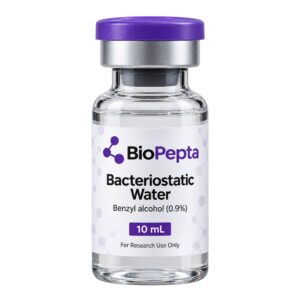
Most research peptides arrive as a lyophilized cake sealed in a glass vial. In the lab, reconstitution means adding a measured volume of diluent, usually bacteriostatic water, so the solid becomes a solution of known strength. Many people favor Hospira-brand bacteriostatic water for its consistent sterility and pH, and avoid generic “reconstitution water” from general retail sites. Several brands list diluents and empty sterile vials in the marketplace.
Keeping vials in good condition
- Before dissolving: the sealed dry form is the stable one and can be stored frozen for a long time.
- After dissolving: keep the vial in the refrigerator and treat its life as limited. A figure often quoted for opened vials is 28 days when refrigerated. Swab the rubber stopper with alcohol every time it is accessed and work on a clean surface.
- Unopened diluent: bacteriostatic water is ordinarily kept at room temperature.
- Labels: write the compound, date and concentration on every vial. A small thermal label printer such as a Niimbot makes this quick and prevents most mix-ups.
The concentration formula
Solution strength is a single division: mg of peptide ÷ mL of diluent = mg/mL. A hypothetical 5 mg vial dissolved in 1 mL gives 5 mg/mL; the same vial in 2.5 mL gives 2 mg/mL. More liquid means a weaker solution, in direct proportion. Record the result on the label and double-check it with a calculator instead of relying on mental arithmetic. These two sites are handy for that check:
Judging the liquid
A successful reconstitution leaves a fully dissolved solution as clear as water, with no sediment and nothing drifting inside. Put a vial aside, make a note of it and, if it arrived this way, tell the brand when you see any of the following:
- Haze that persists after gentle swirling, which may indicate aggregation or microbial growth.
- Flakes, specks or gel-like strands in the liquid.
- A yellow or brown tint in what should be colorless.
- Solid that refuses to dissolve, or a cake that already looked collapsed, damp or discolored before any liquid was added.
Acidity matters too, since pH influences both solubility and shelf stability, which is a good reason to use a well-buffered diluent (source). For photographs and a longer checklist, see what to look for in lyophilized peptides. A vial that looks wrong is a strong candidate for a lab test, and having a result in hand makes any claim you open much stronger.
That covers the groundwork. Work through the other guides at your own pace, and take the first order slowly.
Dosing and Injections
If you are not coming from prescription tirzepatide and so do not already have a dosing schedule, the following is the currently recommend dosage protocol for tirzepatide based on Phase 3 trials.source:
| Month | Week(s) | Dose | Administration Notes |
|---|---|---|---|
| 1 | 1–4 | 2.5 mg/week | Initiation phase; allows the body to adjust to the medication. |
| 2 | 5–8 | 5 mg/week | Gradual escalation to improve efficacy while monitoring tolerance. |
| 3 | 9–12 | 7.5 mg/week | Further dose increase if tolerated; assess GI side effects. |
| 4 | 13–16 | 10 mg/week | Standard therapeutic dose for many patients. |
| 5 | 17–20 | 12.5 mg/week | Higher dose for those needing additional efficacy and tolerating well. |
| 6+ | 21+ | 15 mg/week | Maximum recommended dose; monitor for side effects and adjust as needed. |
If you’re moving from prescription tirzepatide, you can continue using your dosing protocol.
Dosing Schedule Considerations
- Starting Dose: Begin at 2.5 mg or lower to minimize gastrointestinal side effects.
- Dose Escalation: Increase every 4 weeks based on tolerance, but many take this much slower. Sometimes moving up in dose every 2 months or more after adjusting to the 2.5mg starter dose.
- Injection Site: Subcutaneous (abdomen, thigh, or upper arm). Rotate exact injection site weekly.
- Timing: Inject once weekly or every 7 days. Because tirzepatide has a half-life in the body of 5 days, it takes about 20-25 days for it to build up in your body for it’s maximum and steady intended level.source
Dosage Math
- Example:
- A 60mg vial reconstituted with 3mL BAC water = 20mg/mL concentration
- If Desired Dose = 10mg. Draw 0.5mL (or 50 units on an insulin syringe)
- Concentration Calculators
Syringes
31g insulin syringes for injection. The larger gauge needles (25-27g) are used only for reconstitution not dose injections.
SubQ Injections
GLP-1s such as tirzepatide are weekly subcutaneous injections. It’s easier to show than tell!https://youtu.be/jt7SYhALtPk
Injection Site Reactions
Minor redness or stinging? Likely your body’s histamine release or sometimes can be caused when pH is outside of the recommended 4-9 pH range for subQ injections. A small bruise means you managed to actually hit a small blood vessel – no worries! Even developing a minor ISR after a few injections is normal.source
Health Monitoring
If you have a primary care physician you trust, work with them to develop a health panel tailored to your situation. However, be aware that licensed physicians will not condone the use of research peptides and could decline to provide a treatment plan. If that’s the case, your alternative is to take charge of your own health monitoring by conducting periodic blood-work yourself.
For individuals using peptides, it’s generally recommended to run a comprehensive health panel once or twice a year, including:
- HbA1c: To monitor long-term blood sugar control.
- Liver Function Tests (ALT, AST): To check for liver health and detect potential side effects.
- Renal Function Tests (eGFR, Creatinine, BUN): To ensure kidney health.
- Electrolytes (Sodium, Potassium): To check for imbalances that can arise from GLP-1 use.
- Lipid Profile (Cholesterol, Triglycerides): To assess cardiovascular risk.
- Thyroid Function Tests (TSH, Free T4): To rule out any thyroid abnormalities, as these can sometimes be affected.
Lab Panel Providers
These are lab panel providers who do not require a doctor’s orders to fulfill:
- https://www.ondemand.labcorp.com
- https://www.privatemdlabs.com
- https://www.fitomics.org
- https://www.functionhealth.com
Eating Disorders and Malnutrition Risk
We’re here to support your journey toward a healthier relationship with food and your body. GLP-1 medications are meant to normalize hunger responses and support blood sugar control, not to suppress hunger unnecessarily. If using GLP-1s, ensure regular blood work to monitor liver health and blood sugar, and watch forsigns of malnutrition. Seek medical attention if you notice concerning symptoms. Your health is important, even in this space, and if you’re struggling with an eating disorder, reach out to theNational Eating Disorders Association. Let’s get healthy together! ?
Other Tips
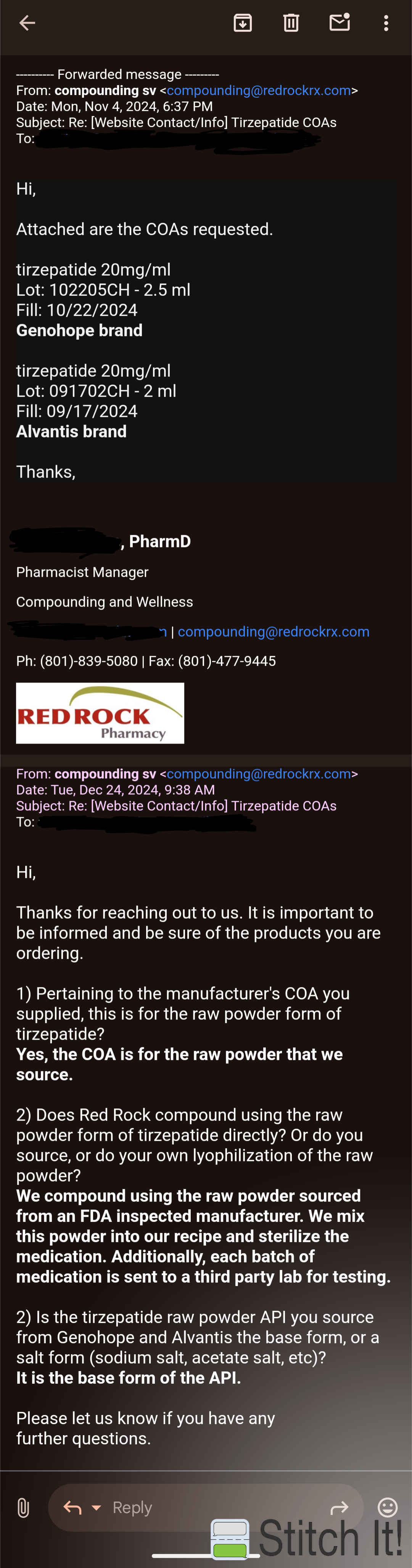
Salt vs. Base Form: Research-grade tirzepatide is pretty much entirely available in salt forms, such as tirzepatide sodium or tirzepatide acetate, whereas the FDA-approved brands Mounjaro and Zepbound and503a/b compliant compounding pharmacies use the tirzepatide base form.Salt forms can influence properties such as pH, shelf stability, and solubility, often improving the latter.source While no peer-reviewed studies have specifically examined tirzepatide salt forms, there are no known health risks associated with using tirzepatide sodium or tirzepatide acetate, which are most commonly found in the research-peptide market. Notably, pharmaceutical salt forms account for approximately 50% of new FDA-approved drugs, underscoring their general safety and widespread use.source However, since salt forms can potentially alter the bioavailability and stability of the active pharmaceutical ingredient (API), it’s reasonable to recognize this distinction — particularly for those transitioning from 503a/b compounding pharmacies, which typically use tirzepatide base raw powder form rather than tirzepatide salt lyophilized powder forms.source
Bad Actors: The research-peptide market is full of opportunists, especially targeting newcomers. NEVER accept unsolicited DMs from anyone looking to sell you stuff; they are almost always scammers pretending to the vendor. If the ‘vendor rep’ of the community you just joined DMs you with a price list, do not reply and block them. Real vendors will not DM you first; you reach out to the vendor yourself. The same rule of thumb goes with phone calls or emails in life. Always go to the known source — for research peptides, that means the brand’s official store or its listing here on GLP1 Chat Vendors. Ask questions before you buy. In this unregulated space, it’s up to us to hold vendors and suppliers accountable — never assume they have your best interests at heart.
Final note: We’re not doctors and anything construed as medical advice here should be discussed with your own primary healthcare provider. We’re passionate about sharing knowledge and promoting harm-reduction strategies. GLP1 Chat Vendors earns an escrow fee on orders placed through the marketplace; this guide is educational and is not a recommendation of any brand.
If you have any questions, concerns, or feedback about the information or sources provided, please contact our support team.